


Phase transformations of spatially confined magnetic shape-memory alloys
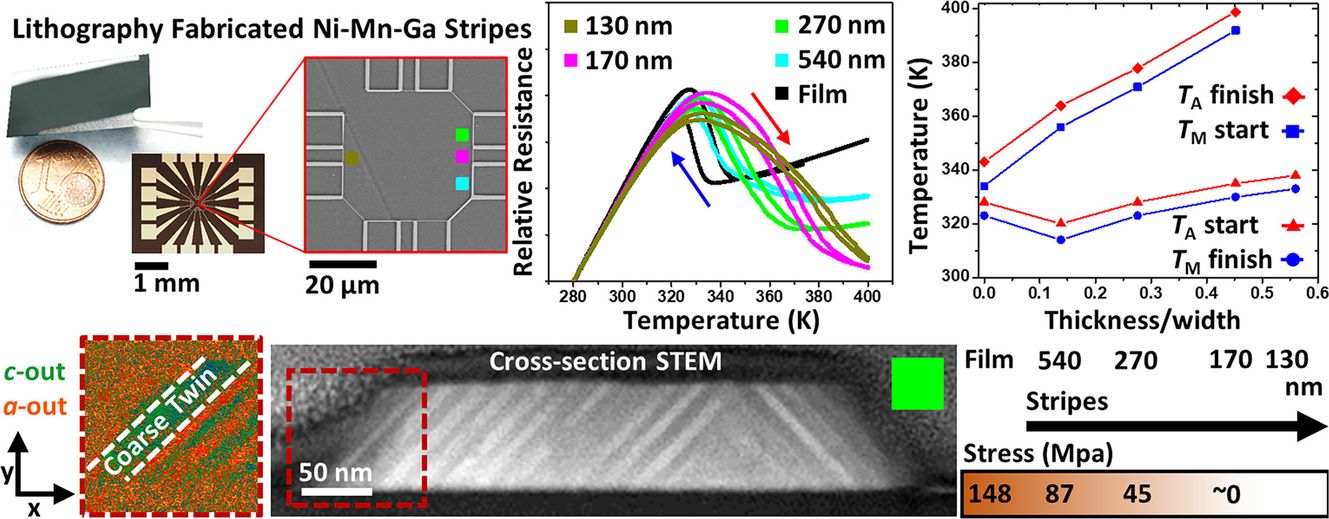 |
Magnetic shape-memory (MSM) Heuslers are among the most promising materials for thermo-magneto-mechanical applications. However, the knowledge about the martensitic transformation as a function of size reduction in the submicron scale is still very limited. Researchers at the Institute of Magnetism, together with international colleagues, investigated epitaxial Ni–Mn–Ga structures with lateral dimensions down to ~70 nm, fabricated by a top‑down approach on MgO(001) substrates. Using transmission electron microscopy and a geometric phase analysis algorithm, a comprehensive analysis and theoretical modeling of the transformation of size-dependent stresses was performed. It was shown that the size-dependent internal stress relaxation plays a primary role in broadening the martensitic transformation of the material, reducing thermal hysteresis, and pushing the transformation toward higher temperatures in the sub-micron structures. These findings highlight the importance of stress considerations upon incorporation of MSM Heusler materials into nanoscale functional devices. M. Takhsha, M. Horký, L. Nasi, A. Kosogor, G. Trevisi, F. Casoli, J. A. Arregi, R. Brescia, V. Uhlíř, F. Albertini, Spatially confined magnetic shape-memory Heuslers: Implications for nanoscale devices, [Acta Materialia 284, 120579 (2025)]. |
Nonlinear decoupling effect in magnonic waveguides
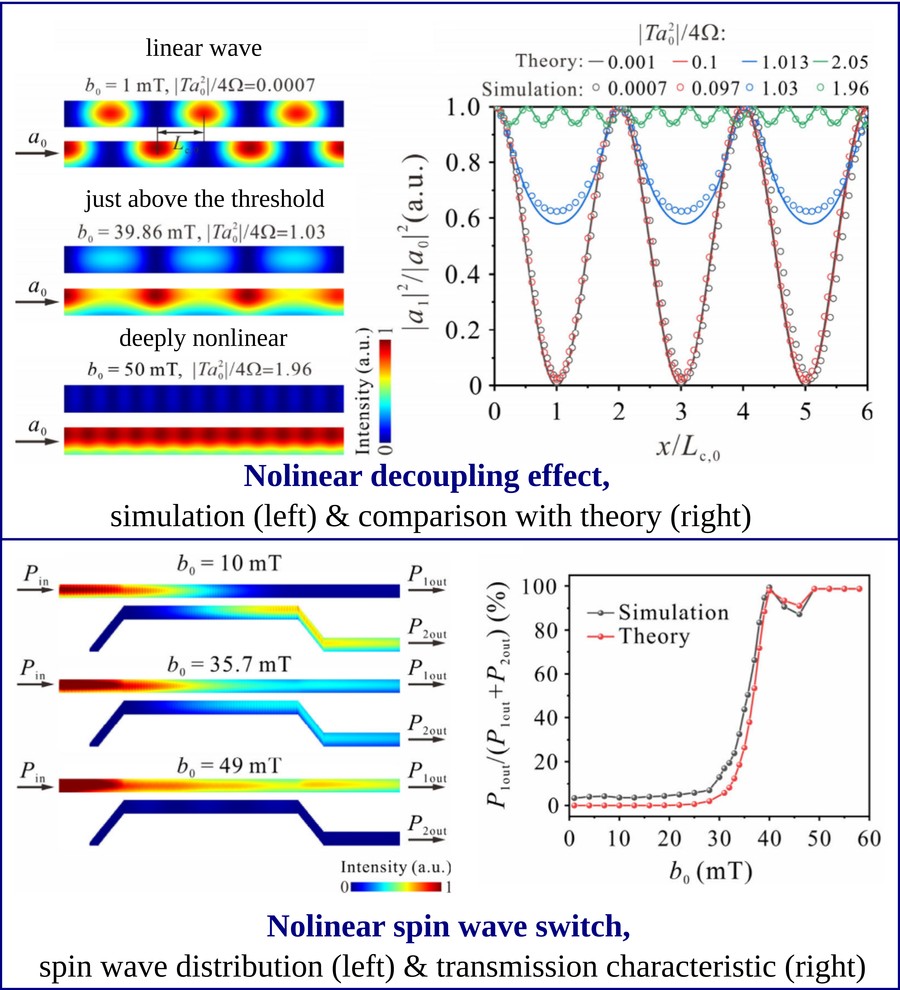 |
Dipole interaction between micro- and nanoscale ferromagnetic waveguides placed in close proximity to each other allows for the creation of directional spin-wave couplers, which can perform the functions of power dividers and combiners, demultiplexers, planar waveguide crossings, etc. The dependence of effective coupling on spin wave wavelength, combined with a weak nonlinear change in wavelength, has previously allowed the creation of weakly nonlinear couplers, which have shown significant potential as key blocks in magnon circuits for binary and non-binary computing. Scientists from the Institute of Magnetism, together with foreign colleagues, have predicted and verified a fundamentally different, universal mechanism of nonlinearity of directional couplers, which arises solely from the nonlinear frequency shift of the spin wave. A strong nonlinear frequency shift causes the coupler to behave as if it consists of non-identical waveguides, suppressing energy transfer between the waveguides. The transition from complete energy transfer between waveguides to a sharp decrease in the efficiency of this transfer, up to its complete blocking, is threshold, with the critical power determined by the equality of the coupling energy and the nonlinear contribution to the magnon energy. The universality of this mechanism allows the creation of nonlinear elements of magnon circuits operating with short high-frequency exchange-dominated spin waves, for which previously studied mechanisms are inefficient. Moreover, the established universal mechanism of coupling suppression should also manifest itself in systems of a different nature, provided that there is a nonlinear shift in wave dispersion. |
Quantitative evaluation of magnetocaloric effect in multiferroics
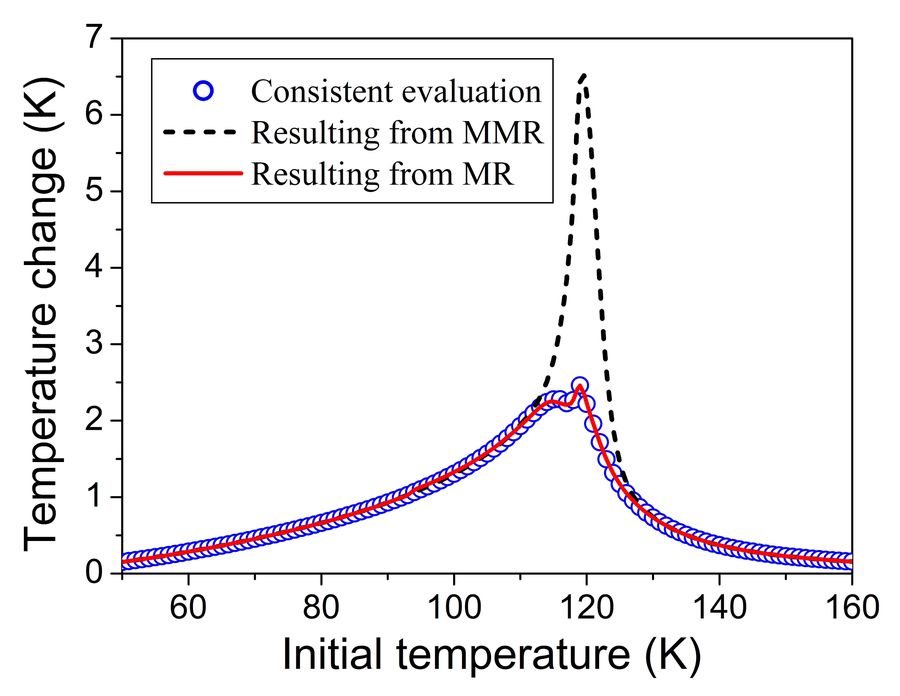 |
A thermodynamic analysis of the magnetic, caloric and magnetocaloric properties of the ferromagnets that undergo the structural phase transformations nearby the Curie point has been carried out; the impact of the structural transformation on the energy of magnetic subsystem of the ferromagnet has been taken into account in course of the analysis. It has been proved that the commonly known magnetic Maxwell relation (MMR) is not suitable for the quantitative evaluation of magnetocaloric effect in such ferromagnets, because this relation results in the substantial overestimation of the expected magnetic-field-induced temperature change (see Figure). A modified relation (MR) has been obtained instead of it and the suitability of the obtained relation for the quantitative evaluation of the magnetic-field-induced temperature change has been proved. The performed theoretical analysis will allow to avoid mistakes in the evaluation of the magnetic-field-induced temperature change. It will promote the effective search of new multiferroic materials promising for the practical use of magnetocaloric effect. V. A. L’vov, O. Salyuk, A. Kosogor, Thermodynamic analysis of magnetocaloric properties of ferromagnet undergoing structural phase transition near Curie temperature, [Sci. Rep. 15, 31002 (2025).] |
Instability of domain wall dynamics and magnon excitation in nearly compensated ferrimagnets
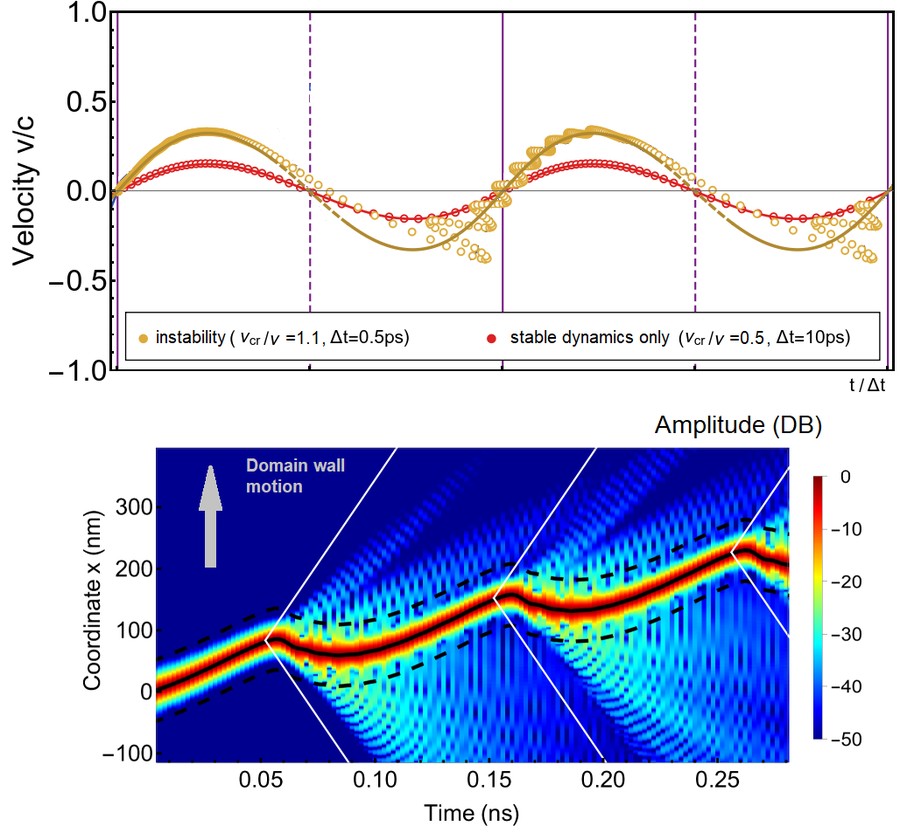 |
A high-frequency spin-Hall nanooscillator is proposed based on a simple magnetic texture, such as a domain wall in an antiferromagnet or a nearly compensated ferrimagnet with easy-axis anisotropy. A spin current polarized along the anisotropy axis excites conical precession of the Néel vector in such a domain wall (contrary to the planar precession in a homogeneous uniaxial antiferromagnet), enabling a stable ac output signal. The frequency of autooscillation can be tuned up to the terahertz range by the strength of the current. Micromagnetic modeling demonstrates that domain wall pinning is crucial for the generator design, which can be achieved by structuring the free layer. It has been shown that the spin current can excite complex dynamic modes of the domain wall, including not only the spin precession at the center of the domain wall but also oscillatory motion of the domain wall's position (left in the figure). These dynamics provide not only significant alternating output spin current, but the excitation of terahertz spin waves propagating at high speeds (right in the figure) far from the domain wall. In this oscillator, the threshold current can be minimized and the output power can increase with increasing frequency. R. V. Ovcharov, B. A. Ivanov, E. G. Galkina, J. Åkerman, and R. S. Khymyn, Instability in domain wall dynamics in almost-compensated ferrimagnets, [Phys. Rev. B 112, 014408 (2025)]. |
Stabilization of magentic skyrmions in hybrid ferromagnetic-superconducting nanostucture
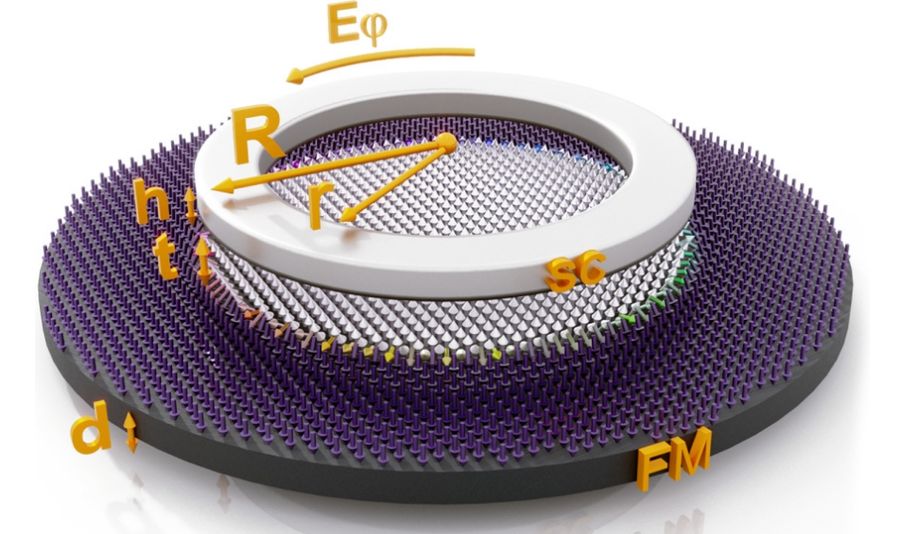 |
Stabilization of scyrmions in magnetic materials without Dzyaloshinsky-Moria interaction requires to incorporation of inhomogeneous demagnetizing or external magnetic fields. It has been proposed to use a superconducting nanoring to locally control and tune the magnetic field in an adjacent ferromagnetic layer. The field generated by a persistent supercurrent stabilizes a Néel skyrmion. The stabilization conditions in ferromagnetic layers with perpendicular magnetic anisotropy as functions of nanoring size and induced supercurrent were analyzed. It was shown that skyrmion stability requires the supercurrent to exceed a critical threshold. Consistent results are presented from analytical modeling and micromagnetic simulations for thin Co and Ga:YIG films. The most significant advantage of skyrmion stabilization by the superconducting ring’s stray magnetic field is the ability to control the skyrmion stability through the current flowing in the ring, which can be adjusted by electric field pulses. This is desired for energy efficient information recording and processing systems, in particular, for neuromorphic magnonic devices. J. Kharlan, M. Zelent, K. Guslienko, V.O. Golub, J.W. Klos, Stabilization of the skyrmion in a hybrid magnetic-superconducting nanostucture, [Phys. Rev. B 112, 224418 (2025)]. |
Spin wave losses in ferrite-paramegnetic structures down to milikelvin temperatures
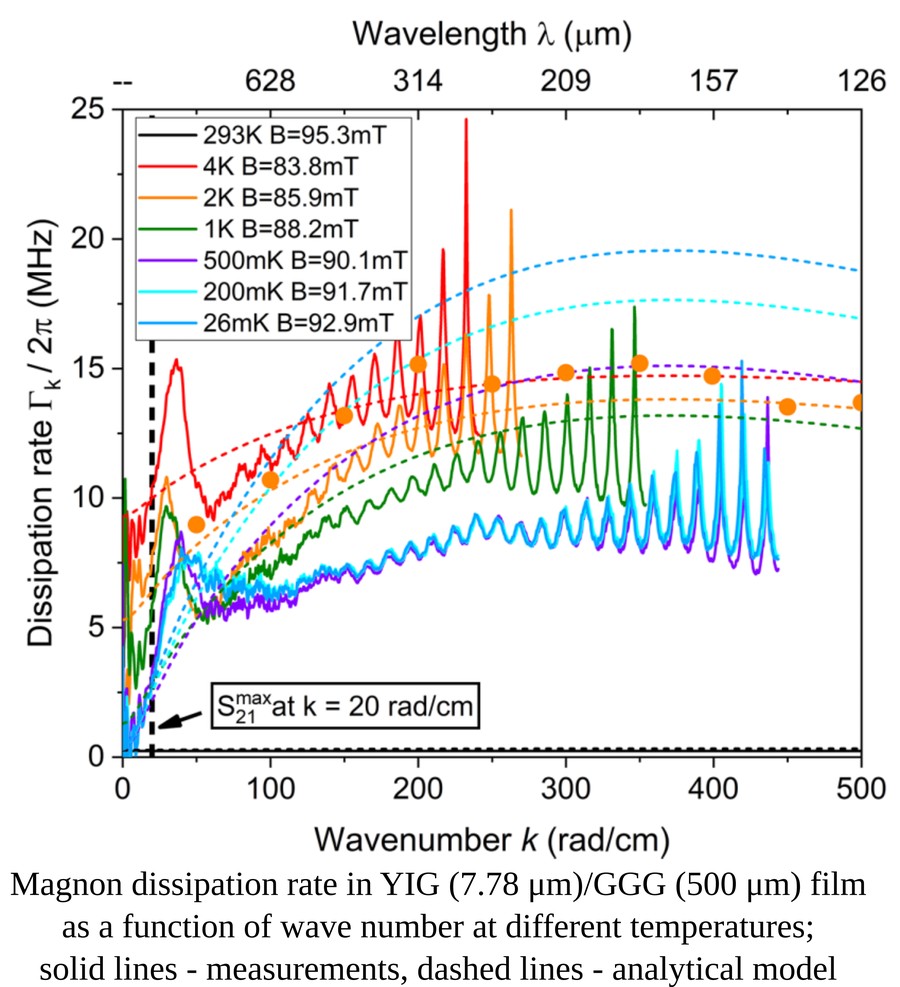 |
Magnons have significant potential for application in prospective quantum technologies and hybrid quantum systems due to their nonlinearity, nanoscale scalability, and unique set of experimentally accessible parameters for manipulating their dispersion. Compatibility with quantum technologies requires long magnon lifetimes at ultra-low temperatures (tens of millikelvins). Due to its record-low magnetic dissipation, ferrimagnetic yttrium-iron garnet (YIG) grown on paramagnetic gallium gadolinium garnet (GGG) is currently considered the most promising material for this purpose. Together with colleagues from the University of Vienna, we investigated for the first time the transport of magnons in a YIG/GGG sample with a YIG thickness of 7.8 μm at cryogenic temperatures from 4 K to 26 mK. A significant dependence of the dissipation rate on the magnon wave number at cryogenic temperatures has been established, which was explained by the dipole coupling with a partially magnetized GGG paramagnetic substrate. The dissipation rate increases with the wave number at low and moderate wave numbers, but begins to decrease when entering the region of exchange spin waves. Moreover, the influence of the GGG substrate is maximal at a temperature of about 1 K, and at lower temperatures, the losses decrease due to the transition of GGG to the antiferromagnetic phase. Our results deepen the understanding of magnon losses at ultra-low temperatures and point the way to reducing these losses, namely by using exchange magnons and temperatures below 1 K. D. Schmoll, A. A. Voronov, R. O. Serha, D. Slobodianiuk, K. O. Levchenko, C. Abert, S. Knauer, D. Suess, R. Verba, and A. V. Chumak, Wavenumber-dependent magnetic losses in yttrium iron garnet–gadolinium gallium garnet heterostructures at millikelvin temperatures, [Phys. Rev. B 111, 134428 (2025)].
|